Best AI Translation Tools in 2026: 10 Smart Apps for Fast and Accurate Translations

Best AI Translation Tools in 2026
Language is not a barrier anymore.
Companies cooperate with clients from other countries. Writers translate their content for audiences in other countries. Tourists use translation applications every day. And even students frequently read articles written in languages they cannot comprehend.
AI made this possible.
Nowadays modern translation AI tools are not only capable of translating words from one language to another but are also able to comprehend the context and adjust the tone. The translations generated by AI often sound much more natural than those provided by traditional machine translation.
If you have already checked our guide to Best ChatGPT Alternatives in 2026, you would notice that now many AI assistants have advanced translation capabilities.
In this guide, we will compare the best AI translation tools in 2026.
Why Should You Use an AI Translation Tool?
The translation must sound natural.
Replacement of one word by another is not enough.
Modern AI translation tools have understanding of grammar, structure, and context. This helps in providing translations that are more understandable and readable.
If you frequently use AI for writing before translating, you may also find our guide on Best AI Tools for Writing in 2026 helpful.
Some advantages of using an AI tool include:
- Quicker translations
- Improved context
- Multilingual support
- Translation of documents
- Website localization
- Voice translations
- Conversational conversations
Regardless of whether you are translating an email or a whole report, the process will save much time.
Quick Comparison
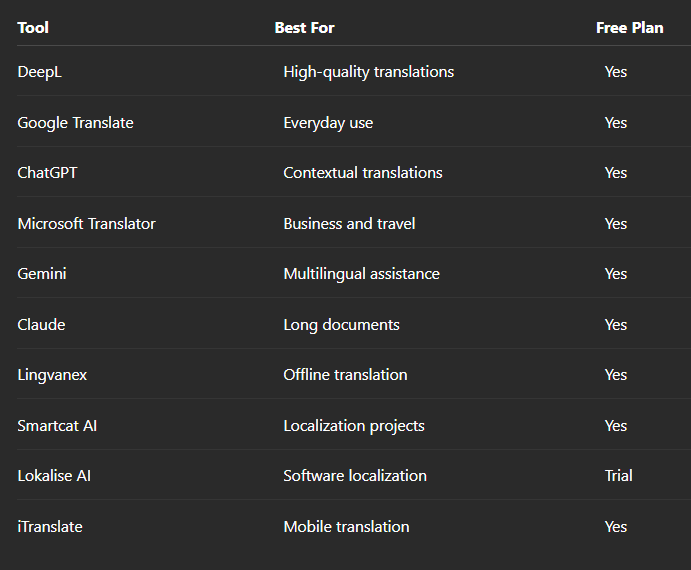
1. DeepL
DeepL gained its reputation because of natural-sounding translations.
Professional people prefer it for the translation of business documents because it is able to preserve the tone and the meaning of the original text better than traditional translation systems.
Best for
- Business documents
- Professional writing
- Academic content
2. Google Translate
Google Translate is one of the most popular translation tools.
It supports a vast variety of languages and can translate texts, voices, images, and websites.
Best for
- Everyday translations
- Travel
- Quick conversations
3. ChatGPT
ChatGPT is convenient to use in case when context is important.
Instead of translating each sentence separately, it is possible to ask the tool to preserve the tone, simplify the wording, and adapt the content for a certain audience.
It is especially convenient for marketing, blogging, and professional conversations.
4. Microsoft Translator
Microsoft Translator works great with Microsoft 365 and Teams.
Businesses often use it for multilingual conversations, presentations, and collaboration.
5. Gemini
Gemini deals with multilingual conversations naturally and is convenient for translation of explanations, emails, and educational content.
Its conversational approach allows following-up the questions easily.
6. Claude
Claude translates long documents efficiently.
Moreover, it explains difficult expressions. Thus, it is especially useful for researchers, writers, and students.
7. Lingvanex
Lingvanex provides online and offline translations on different devices.
It is a good option for users who need to translate content while travelling.
8. Smartcat AI
Smartcat AI combines AI translation and professional localization workflows.
It is chosen by companies that have multilingual websites and documentation.
9. Lokalise AI
Lokalise is specialized in software localization.
Development teams use it to manage translations on websites, mobile apps, and digital products.
10. iTranslate
iTranslate is specialized for mobile users.
It offers text, voice, and camera translations. Thus, it is good for travels and everyday communication.
Which AI Translation Tool Should You Use?
It depends on your needs.
If the quality of translations is crucial, then DeepL is a great option for you.
If you need to communicate and travel, Google Translate is among the simplest tools.
Writers and marketers prefer ChatGPT as it is able to adjust the tone instead of translating only words.
Businesses that deal with multilingual documents can use Microsoft Translator and Smartcat.
Instead of searching for a perfect translator, you should choose the tool that suits your workflow better.
If you're comparing different AI assistants beyond translation, check out our comparison of AI Search Engines and Best ChatGPT Alternatives in 2026.
Is It Possible for AI to Replace Human Translators?
No, not completely.
AI is really efficient in cases of everyday communication, technical documents, and business writings.
However, human translators still have some advantages when dealing with literature, legal agreements, cultural references, and creative content.
Many organizations prefer to combine AI and human translator to gain high-speed translations and their quality.
If you want more accurate translations from AI assistants, learning How to Write Better AI Prompts can make a significant difference.
Final Thoughts
AI translation has improved a lot during the last years.
What used to require professional translation for each document now can start with the generation of the text by AI.
It does not mean that all translations must be published without checking.
The best result can be achieved when using AI to accelerate the process and human translator for checking it.
Many professionals also include translation as part of larger AI Workflows to automate multilingual content creation, customer support, and documentation.


