Best AI Tools for Writing in 2026: 12 Tools That Save Time and Improve Content

There's no doubt that writing has been transformed significantly over the past few years. Whether you're writing a blog, creating marketing content, composing an email, or completing your homework assignment, AI can help you do it faster.
However, not all AI writing assistants are equal.
Some are amazing when it comes to long-form blog posts. Others are best for grammar, social media, or SEO. Knowing which AI writing assistant to pick will save you many hours every week.
In this article, we'll take a look at the best AI writing tools in 2026 and the features that they offer.
Why Use an AI Writing Tool?
AI doesn't replace human creativity. Rather, it allows you to:
- Write faster
- Overcome writer's block
- Improve grammar and readability
- Generate ideas instantly
- Optimize content for SEO
- Rewrite and summarize text
- Write social media posts, emails, and marketing copy
Most people use AI to compose a first draft and polish it later to their liking.
1. ChatGPT
Best for: General writing, brainstorming, blogs, emails, coding, research
One of the most versatile AI writing assistants out there is ChatGPT. You can use it for anything including writing articles, explanations of complicated concepts, ideas generation, improving your existing content, and even coding.
Pros
- Excellent writing quality
- Supports long-form content
- Great brainstorming tool
- Matches different writing styles
- Helps with many tasks other than writing
Cons
- Advanced features require a subscription
- Occasionally provides outdated info without web access
2. Claude
Best for: Long documents and natural writing
Claude is known for its ability to produce natural, human-like writing. It does an excellent job with long documents and keeps the context even during lengthy conversations.
Pros
- Excellent readability
- Strong editing and rewriting capabilities
- Works well with long documents
Cons
- Has a smaller ecosystem than some of its rivals
3. Google Gemini
Best for: Google Workspace users
This writing assistant integrates seamlessly with Google Docs, Gmail, and other Google services.
If you spend most of your time working in Google's ecosystem, Gemini is a great choice.
Pros
- Works well with Google services
- Great research abilities
- Powerful productivity features
Cons
- Some of the advanced features require a premium plan
4. Jasper AI
Best for: Marketing teams
The main focus of Jasper is marketing content such as:
- Blog posts
- Product descriptions
- Facebook ads
- Google Ads
- Landing pages
- Sales emails
This is a popular AI among businesses as it has brand voice features.
Pros
- Great marketing templates
- Collaboration for teams
- Brand voice support
Cons
- Very expensive comparing to other similar tools
5. Grammarly
Best for: Grammar and proofreading
Although Grammarly isn't an AI writing assistant, it's one of the best editing assistants available.
It checks:
- Grammar
- Spelling
- Tone
- Clarity
- Sentence structure
Pros
- Accurate corrections
- Works almost everywhere
- Very easy to use
Cons
- Limited content generation
6. Copy.ai
Best for: Sales and marketing copy
Copy.ai is great for writing:
- Sales emails
- Product descriptions
- Marketing campaigns
- Social media captions
It's a business tool designed mostly for startups.
7. Writesonic
Best for: SEO content
With Writesonic, you can combine your AI writing abilities with SEO features.
You get the ability to generate articles aimed at search engines rankings but with good readability.
8. Rytr
Best for: Beginners
Simple, affordable, and easy to learn – those are the characteristics of Rytr.
If you're new to AI writing, it's one of the best places to start.
9. Notion AI
Best for: Productivity and note-taking
If you're already using Notion, you'll be able to benefit from its AI which can:
- Summarize notes
- Generate documents
- Rewrite text
- Create meeting summaries
All this happens within your workspace.
10. Sudowrite
Best for: Fiction writers
As its name suggests, Sudowrite focuses on creative writing.
Novelists find it useful for:
- Creating characters
- Story development
- Dialogue
- Scene descriptions
11. QuillBot
Best for: Paraphrasing
QuillBot specializes in rewriting text without changing its meaning.
It's a popular tool among students, researchers, and writers to improve readability.
12. Perplexity AI
Best for: Research-based writing
Perplexity uses web search combined with AI so it can provide facts and sources along with the generated text.
Rather than just generating text, it shows where this information comes from.
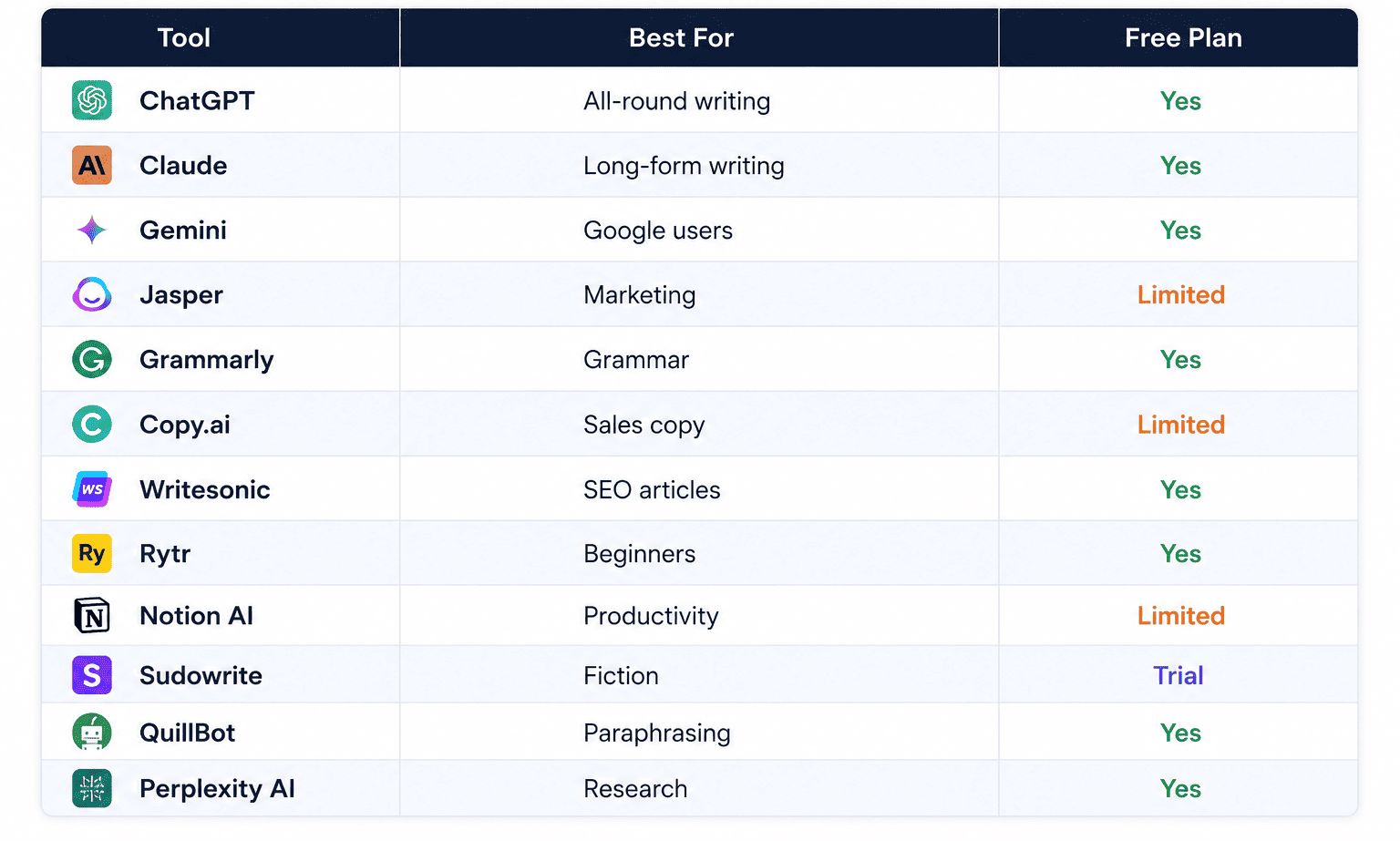
Quick Comparison Table
How to Choose the Right AI Writing Tool
What's the best tool depends on what you write.
Here's how you can pick the right AI assistant based on your requirements:
- Choose ChatGPT if you need one tool for everything.
- Pick Claude if you're writing long articles or reports.
- Go for Gemini if you're working with Google Docs on daily basis.
- Try Jasper for your marketing campaigns.
- Use Grammarly for editing.
- Select Writesonic for your SEO articles.
- Use Rytr if you're on a budget.
- Try Sudowrite for your novels and stories.
- Pick Perplexity for your research-heavy content.
Can AI Replace Human Writers?
Not completely.
AI is great when it comes to creating drafts and ideas generation. However, human writers bring:
- Experience
- Creativity
- Emotion
- Critical thinking
- Original opinions
The best combination is to work with AI and then edit your content by yourself.
Frequently Asked Questions
Which AI writing tool is the best overall?
ChatGPT is one of the best AI writing tools overall as it supports blogging, marketing, coding, brainstorming, and editing in one place.
Are AI writing tools free?
Most of the AI writing tools offer free plans with limited usage. The paid plans give you faster performance, higher quotas, and extra features.
Can AI help me with my SEO writing?
Sure, some of the tools like Writesonic, Jasper, or ChatGPT can generate SEO-friendly articles if you give it the correct keywords and structure.
Is the AI-generated content good for Google?
Yes, as long as it's original, accurate, useful, and helpful to the reader. The low-quality or spammy AI-generated content won't work well.
Final Thoughts
AI writing tools have become a must-have for bloggers, marketers, students, and businesses. They allow you to significantly decrease the time spent on writing and improve the quality.
The right choice for you will depend on your workflow.
If you need one versatile assistant, ChatGPT is the hardest to beat. If you want to focus on marketing, try Jasper. For editing purposes, Grammarly remains one of the best choices.
Whatever you choose, you should always remember that AI works best with your ideas, expertise, and final revision.
By using AI as a partner rather than a replacement, you'll be able to write faster and produce better content.


